Skip to content
 0
0The Monday Ritual
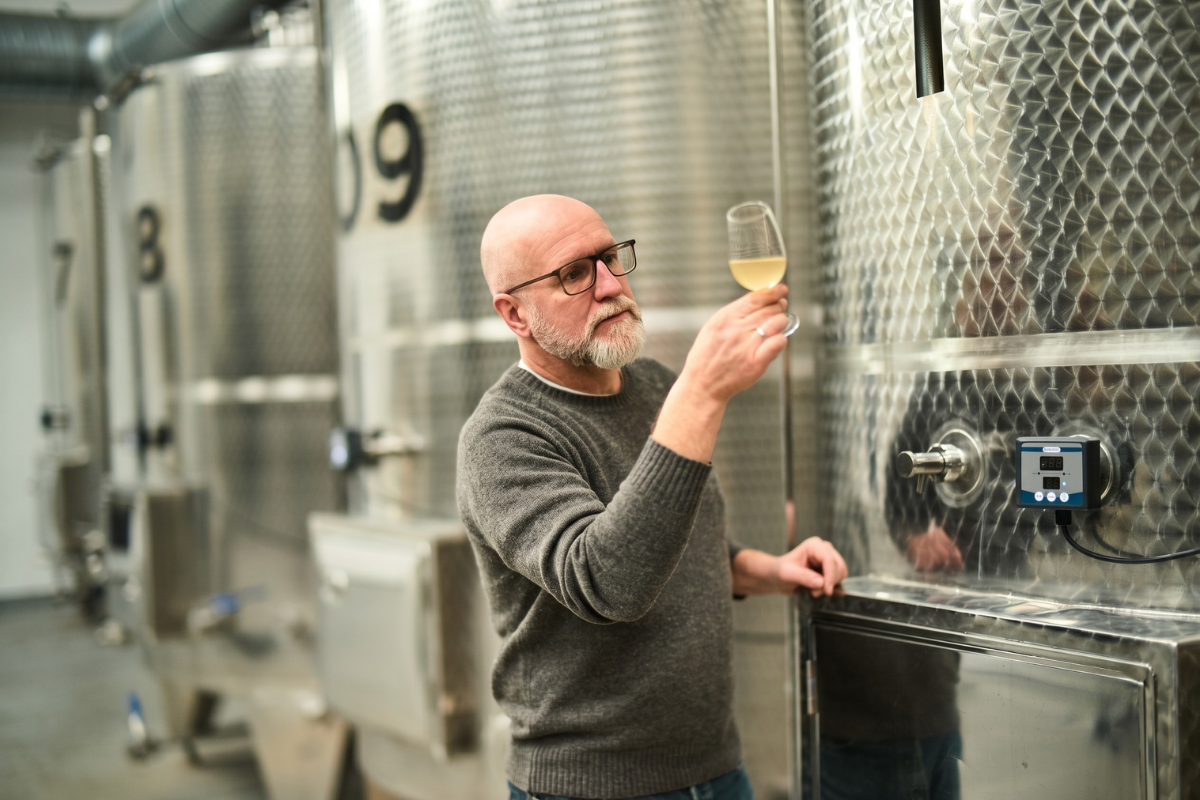
It's Monday morning, and I'm heading into the fermentary. Every Monday, without exception, is tasting day. Thirty-two tanks, each at a different stage of fermentation, each one tasted in sequence by me and the team. It's methodical, it's rigorous, and after nearly a decade of doing this, it still gives me the same thrill it did when we were testing our first batches on a kitchen counter.
At The REAL Co., we are deeply science-based. We use carefully controlled fermentation science to develop our process, and we measure all the key parameters obsessively — pH, acidity, sugar content, microbial activity — to ensure our products land within the same precise boundaries every time. But here's what no instrument can tell you: whether a drink is truly beautiful.
For that, you need a human tongue.
The human palate is an extraordinary instrument. We have thousands of taste receptors capable of detecting vanishingly small concentrations of compounds — acids, esters, phenols — that together create the complex, layered character of a truly great fermented drink. No spectrometer, no chromatography report, no data dashboard can replicate the holistic, immediate judgement of a skilled taster. Science tells us what is in the liquid. Tasting tells us what it means.
So every Monday, we go tank by tank. What we're listening for — because tasting really is a form of listening — are two things: what shouldn't be there, and what should.
The first concern is off-flavours. Yeast and bacteria, when stressed or out of balance, can produce small amounts of unwanted compounds. These might present as an astringency, a harsh edge, a faint chemical note — subtle enough that an untrained palate might miss them, but unmistakable to us. Catching them early means we can intervene: adjusting temperature, modifying ingredients, or adding carefully chosen fermentation aids to bring the culture back into balance.
The second, and more joyful, part of the tasting is chasing the flavours we're actually after. For us, that means esters — the organic compounds produced by yeast during fermentation that carry the fruity, aromatic character of our drinks. Many people will remember pear drop sweets from childhood. That distinctive pear flavour is actually isoamyl acetate, a single ester produced by yeast. But yeast produces hundreds of different esters, and the particular combination we nurture in each of our products gives them their distinct personality.
In our Sec, we're looking for white peach and rhubarb. In our Dry, it's sweet lemon and grapefruit. In our Blush, summer and forest fruits — strawberry, blackberry, raspberry — woven together. These aren't flavourings. They emerge entirely from the fermentation itself, the natural expression of yeast and bacteria working in harmony with our tea base.
Alongside esters, we're tasting for acid balance. Our mixed cultures of bacteria each produce different organic acids — acetic, lactic, gluconic among them — and it's the ratio and depth of these acids that gives our drinks their sharpness, their smoothness, their length on the palate. Getting that balance right is where science and intuition converge.
By the end of a Monday tasting session, we've made notes on every tank, identified anything that needs attention, and planned whatever small interventions the liquids require to reach their potential over the remaining weeks of fermentation. Three to four weeks from start to finish, tank to bottle, with tasting woven through every stage.
Ten years in, I'm still as passionate about this process as I was at the very beginning. Because every tank, every batch, every sip is a reminder of why we started: to make something genuinely extraordinary.